“Mirror, Mirror, on the Wall”
Abstract
This paper analyzes literature as a means of embodying the notion of the Other in the light of possible synthesis of perspectives of philosophers such as Hegel, Bakhtin, and Levinas, and highlights the possible uses of mirrors in literature, not only as descriptive elements but as symbols with far deeper meanings than that. To achieve this goal, several aspects of three pieces of literature from different ages were selected and analyzed: Brothers Grimm’s “Snow White”, Lewis Carroll’s “Through the Looking Glass”, and Kenneth Branagh’s film “Hamlet”. The paper elucidates the fact that mirrors enable plot exposition in these works by serving as little, compact scenes in which characters address their inner worlds in the eyes of others and their own. The narrative conclusion of this critical essay, therefore, states that the use of the concept of otherness in other works of literature has been stigmatized. Mirrors are put into practice not only as artifacts within the drama. Instead, they are integrally treated as antagonists who have a noticeable effect on the self-development or self-image of others or both.
Introduction
In the Middle Ages, mirrors were an important part of religious life. Witches performed divination with mirrors, vampires could be identified by not appearing in mirrors, and mirrors also held symbolic meanings, such as association with the supernatural (Hodges, 2023c). Reflecting the belief that mirrors lead a metaphorical life on top of a utilitarian one, the literature that followed used this to their advantage. According to Goodreads, there are 384 novels about mirrors (Glass and Mirrors (384 Books), n.d.), and IMDb counts a total of 4,409 movies containing mirrors (Advanced Search, IMDb). When looking at such numbers, it may be concluded that mirrors have become an important symbol for later literature as a tool for character and plot development. As the mirror became an important symbol before the modern era, the research will be conducted on three pieces of literature written in different eras: “Snow White,” by the Brothers Grimm, Through the Looking Glass, by Lewis Carrol, and Hamlet (1996, four-hour uncut version), a film directed and lead by Kenneth Branagh. This essay examines how mirrors are important, and how they tie into the philosophical idea of the Other.
Often appearing in interdisciplinary works, mirrors are used in literature to represent philosophical and psychological theories. In many cases, the use of mirrors in literature, both old and new, represents an internal struggle, a new self-perception, or a deep desire that prompts deeper rumination and self-discovery for characters who require deep introspection. By looking at themselves in the mirror, characters have the opportunity to see themself as others see them, thereby combining the outside view with their knowledge of themself. The mirror touches upon the complex relationship between the Self and the Other, offering insights into human existence, and for fictional characters, mirrors provide a space for characters to confront their inner fears, desires, and insecurities, prompting deeper contemplation and self-discovery.
The following pieces were chosen as they represented different time ranges. “Snow White” was published in 1812, Through the Looking Glass in 1871, and Hamlet in 1996 (and the original script around 1600). By analyzing these three pieces, the application of mirrors can be seen not as a coincidence but as a cultural symbol across the ages.
“Snow White” is a German fairytale, first published by the Brothers Grimm in their collection Grimm’s Fairy Tales as Tale 53. It is a classic fairy tale about a young princess whose beauty incites the jealousy of her stepmother, the Queen. The Queen has a Magic Mirror that she consults daily, asking, “Mirror, mirror on the wall, who’s the fairest of them all?” (In some translations, “Looking-glass upon the wall, Who is fairest of us all?”.) The mirror, a symbol of the Queen’s vanity and insecurities, always responds to her queries, reinforcing her belief in her beauty until it one day declares Snow White to be the fairest. Consumed by envy and fear of being usurped, the Queen orders Snow White’s death, but the princess escapes and finds refuge with the Seven Dwarfs. The mirror then informs the Queen of Snow White’s survival, driving her to further attempt to harm Snow White. Ultimately, the Queen is punished by dancing in red-hot boots until she drops dead.
Through the Looking Glass is the sequel to the famous Alice’s Adventures in Wonderland, one of the most well-known children’s stories by Lewis Carroll (real name Charles Dodgson), remembered for its vibrant imagination and somewhat scathing irony for those who understand it. Through the Looking Glass is set in an even more fantastical world than the last, where flowers talk because they are planted in hard ground, one stays in the same place even if one sprints, and all the characters can be found somewhere in the checkerboard box. In this world, she encounters peculiar characters like Tweedledum and Tweedledee, the Red Queen, and Humpty Dumpty. The narrative is filled with playful language, puzzles, and paradoxes, mirroring the whimsical logic of dreams. Alice’s journey is structured like a game of chess, with her moving from a pawn to a queen.
Kenneth Branagh's 1996 film adaptation of Shakespeare’s Hamlet is a full-length, unabridged version of the play, set in the 19th century. The film tells the story of Prince Hamlet of Denmark, who is driven by revenge after learning that his uncle Claudius murdered his father to seize the throne. As Hamlet grapples with his grief, anger, and indecision, he feigns madness to uncover the truth, leading to tragic consequences. Branagh’s adaptation is notable for its grandeur, elaborate set designs, and faithful rendering of Shakespeare’s text. The film delves into themes of betrayal, madness, mortality, and the complexities of human emotion, capturing the timeless depth of the original play.
The Other
The concept of the “Other” comes from German Idealism. It is a philosophical and literary idea that refers to a being that is different from the Self. In simple terms, the Other is about how we see and understand people who are not like us—those who belong to different cultures, races, genders, or any other characteristic that separates “us” from “them.” This concept is often used to explore themes of identity, alienation, and how our understanding of ourselves is shaped by our perceptions of others. In literature, the “Other” often represents characters or forces that challenge the protagonist’s sense of self, leading to deeper introspection and conflict.
Important philosophers on the topic include Hegel, Bakhtin, and Levinas. Hegel explored the concept of the “Other” primarily through his Phenomenology of Spirit, where he discussed the dialectical process of self-consciousness. According to Hegel, self-awareness arises only in relation to another self-conscious being, the “Other.” This interaction is essential for individuals to achieve self-recognition and identity. In his famous Master-Slave dialectic, Hegel shows how this relationship involves a struggle for recognition, leading to a dynamic where the Self and the Other are interdependent. Bakhtin, a Russian philosopher and literary critic, introduced the idea of “dialogism,” emphasizing the importance of dialogue in understanding the Self and the Other. For Bakhtin, the self is not a closed, autonomous entity but is always in dialogue with others. He extended this idea to literature, where characters are seen as voices in a dialogic interaction. Bakhtin also explored the concept of the mirror as a metaphor for self-reflection and the relationship between the Self and the Other. In his view, a mirror reflects not just the Self but the interaction of multiple perspectives, emphasizing the multiplicity of identities and the fluid nature of selfhood. Levinas, a French philosopher, focused on ethics and the primacy of the Other in the formation of the Self. For Levinas, the face of the Other is central to his philosophy. The face represents the Other’s vulnerability and calls for a response from the self, creating an ethical obligation. Levinas argues that the Self’s identity is shaped not by dominance over the Other (as in Hegel’s dialectic) but by responsibility and care for the Other. The encounter with the face of the Other challenges the Self to move beyond egoism and embrace an ethical relation that acknowledges the Other's alterity and humanity.
From their theories about the Other in connection with mirrors, faces, and general appearance, this paper will analyze the presence of the Other in stories across the ages containing mirrors.
Snow White
This section will discuss the textual and symbolic meanings of the Magic Mirror in “Snow White.” Contextually, the mirror moves the plot forward. Similarly, as the mirror is one of the main symbols in the story, it represents the vanity and insecurity of the Queen, as well as period-typical feminine stereotypes relating to vanity.
First, the meaning of mirrors in the philosophical idea of the Other is considerable. As Bakhtin, one of the main philosophers writing about the Other, asks in Art and Answerability (paraphrased): when one looks in the mirror, does it show their image (their Self) or only how others around them (their Other) see them? As the Queen is standing before the mirror, the image she sees is ambivalent; it is both her Self and her Other. When the Queen asks the mirror about her beauty, she does not directly ask “How beautiful am I?” but rather asks “Who’s the fairest of them all?” This reveals the Queen’s obsession with beauty through competition, an unhealthy traditional stereotype of women fighting for the love of men. Through the magic mirror, her deepest insecurities, vanities, and jealousy are reflected. As there is no speech given by the king in the story, nor a description of whom the Queen shows her beauty to but the mirror, the patriarchal voice of the Mirror that alerts the Queen to the loss of her beauty could be deciphered as the king’s (Golden & Canan, 2004) - this is the voice that sets the Queen against her stepdaughter in female competition, due to her insecurity at losing her husband’s love. In this regard, the Queen is listening to the voice of her Other. This Other could be society or it could be the voice of her husband, but no matter which it reflects the viewpoint given by others, telling her that she is losing to another woman.
However, the voice in the mirror could also belong to herself. The cultural symbolic meaning of mirrors includes jealousy and vanity, coming from the myth of Narcissus, who looks at himself in the pool as a mirror until he turns into a flower. When Snow White is yet a child, she is already quite beautiful — “skin as white as snow, lips as red as blood, and hair as black as ebony.” But the Queen does not seek to harm her and the Mirror repeats the beauty of the Queen. However, when Snow White reaches fifteen, the age for adulthood back then, when her childish beauty develops into nascent womanhood, the Queen feels the threat of this newborn beauty. Her self-reflection and self-perception in the mirror prompts her to recognize her insecurity. She then feels outraged, scared, and jealous of Snow White’s beauty. As her self-perception changes to become less confident, she starts to see Snow White as a competitor in beauty and status. The mirror is powerful and incisive, only showing the beauty of people who the Queen sees as a threat. This implies the beauty in the eyes of the Mirror is not omniscient but is rather confined to a subjective perspective of the Queen, or those close to her, speaking her inward fears. Thus, the voice inside the mirror also comes from inside the Queen, where her self-perception changes for the worse.
In addition to presentation and self-perception, the role of the Mirror makes the Queen an active villain in her psychological drama. In opposition, Snow White, who is a passive heroine, does not fight back against the Queen, allowing herself to be threatened and even killed by the huntsman, and learns to be subordinate and submissive while she is with the dwarves - “If you will keep our house for us, and cook, and wash, and make the beds, and sew and knit, and keep everything tidy and clean, you may stay with us, and you shall lack nothing,” - and so she becomes the passive heroine in the story. The mirror, posing as the Queen’s Other, stimulates her knowledge of herself and pushes her to become an active participant, according to the concept that one can understand the Self better if it is opposed to its Other. In the story of “Snow White”, the Mirror acts as an Other to reflect uncomfortable psychological truths that uncover concealed fears, desires, and extreme behaviors.
Interestingly, this fairy tale utilizes the stereotypical narcissistic female character. The archetypical woman-and-the-mirror image is spurred by period-typical sexism that states women must take care of their appearance. The Brothers Grimm, in their portrayal of the Queen, create a character whose value and identity are entirely tied to her physical beauty, reflecting the societal pressures of their time. The Queen does not feel threatened because Snow White is a nicer person but simply because she is prettier. The Queen’s obsession with the mirror is more than mere vanity; it is a manifestation of the oppressive societal expectation that women’s worth is measured by their looks. This image of the Queen, perpetually seeking validation from the mirror, highlights the destructive impact of these pressures, leading her to extreme actions to preserve her beauty and power. The Grimms’ choice to frame the Queen’s downfall as a consequence of her narcissism might be read as a continuation of this oppressive dynamic, illustrating how society expects women to be beautiful.
In conclusion, the Magic Mirror in “Snow White” serves as a powerful symbol that reflects both the Queen’s inner turmoil and the societal pressures placed on women. Through the mirror, the Queen’s insecurities and vanities are laid bare, revealing the complex interplay between self-perception and the perception of others. The mirror not only drives the plot forward but also acts as the Queen’s Other, forcing her to confront uncomfortable truths about herself. This psychological drama, underscored by the Queen’s obsession with beauty, exposes the destructive impact of a society that values women primarily for their appearance. The Queen’s death, rooted in her narcissism and fear of losing her beauty, illustrates the oppressive expectations of the time and highlights the tragic consequences of such a narrow definition of a woman’s worth. Ultimately, the mirror in “Snow White” is more than a plot device; it is a window into the dynamics of identity, power, and societal expectations.
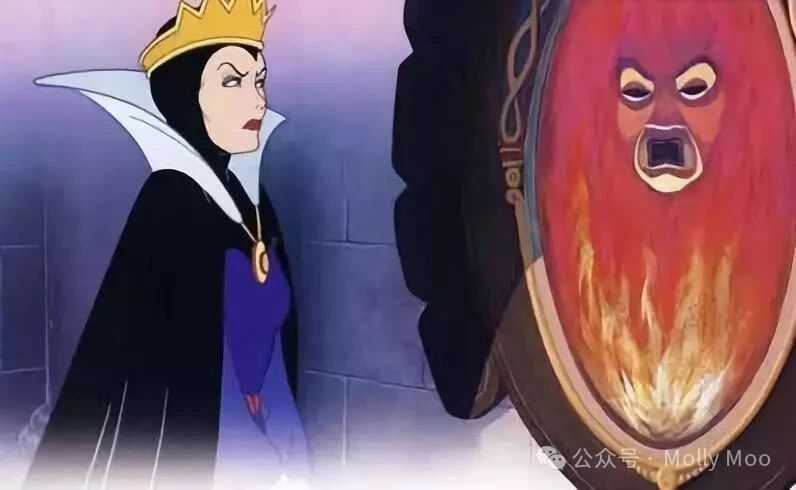
The classic Disney rendition of Snow White's Queen and Mirror
Through the Looking Glass
Alice’s new journey through the Looking Glass is a strange world where common sense has no operating grounds. The Looking Glass isolates Alice from her known society, throwing her into an unfamiliar Otherworld where she must find her path without guidance from her previous knowledge. This world symbolizes the subconscious mind that takes on flexible structures, much like how dreams function. Alice navigates a terrain that defies common understanding by using the mirror as a gateway. The mirror that Alice falls into represents the threshold between reality and the Otherworld, suggesting that our world and this Otherworld are connected, thus implying that our Self and Other are separated by only a mirror. In this Otherworld, Alice encounters new things that make her question her reality, redefining her identity and place within this jabberwocky realm.
In this new Otherworld, Alice is thrown against the Other society, trying to learn their rules but always set in opposition. As the story is molded after a chess game, the rules of the Otherworld loosely adhere to chess too. When Alice, as a pawn, finally moves to the last square to become a Queen, both the existing Red and the White Queen disapprove of her behavior. This shows her separation and perhaps even segregation from the characters in the Otherworld, accentuating the idea that the mirror world, while connected to our own, operates under its distinct logic and principles. The title Through the Looking Glass suggests an exploration beyond the familiar, but paradoxically, there is a lack of mirrors within the story itself, highlighting the idea that Alice’s journey is less about literal reflection and more about introspection and the discovery of hidden aspects of the Self.
The Otherworld in Through the Looking-Glass serves as a stark contrast to Alice’s familiar reality, emphasizing her Otherness and highlighting her isolation. Unlike her world, where societal norms and logic prevail, the Otherworld operates under its own bizarre rules, forcing Alice to adapt and question her understanding of the world. The characters she encounters, such as the White Knight and the Red Queen, embody the eccentricity and unpredictability of this realm. The word ‘strange’ appears multiple times in the text when she is referring to or speaking with the White Knight, when she thinks he looks and talks strange, symbolizing her discomfort and curiosity in the Otherworld. Their strange and disparate lives challenge Alice’s preconceived notions, pushing her to reassess not only the world around her but also her own beliefs and conservatism.
As Alice navigates this peculiar landscape, she becomes increasingly aware of the fluidity of identity and reality. The Otherworld acts as a mirror, distorting and exaggerating the values and norms of her world. In this reflection, Alice is confronted with exaggerated versions of her society’s rules, forcing her to recognize the absurdity and limitations of those conventions. The characters she meets are not just foreign to her; they represent aspects of her world, albeit in twisted, unfamiliar forms. This confrontation with the unfamiliar challenges Alice to reevaluate her understanding of herself and her place in the world.
The journey through the Otherworld is, therefore, a metaphorical exploration of self-discovery. By engaging with the Other, Alice is compelled to confront parts of herself that she had not previously considered. The Otherworld, with its peculiar inhabitants and nonsensical rules, acts as a catalyst for Alice’s introspection, leading her to question the very nature of reality and her role within it. The boundaries between the familiar and the unknown blur, revealing that the Other is not as distant or alien as it first appears. Instead, it is a reflection of the self, a distorted mirror that forces one to confront their own identity in new and unsettling ways.
Ultimately, Alice's encounter with the Otherworld is a journey of self-discovery, where the familiar and the foreign merge to reveal deeper truths about identity and reality. The characters she meets, though strange and seemingly disconnected from her world, are reflections of her own experiences and beliefs. Through this process, Alice learns that the Other is not just a contrast to the self but is instead an integral part of it, highlighting the interconnectedness of all experiences and the fluid nature of identity. The Otherworld, then, is not just a place of wonder and confusion but a space where the self is reflected, challenged, and ultimately understood.
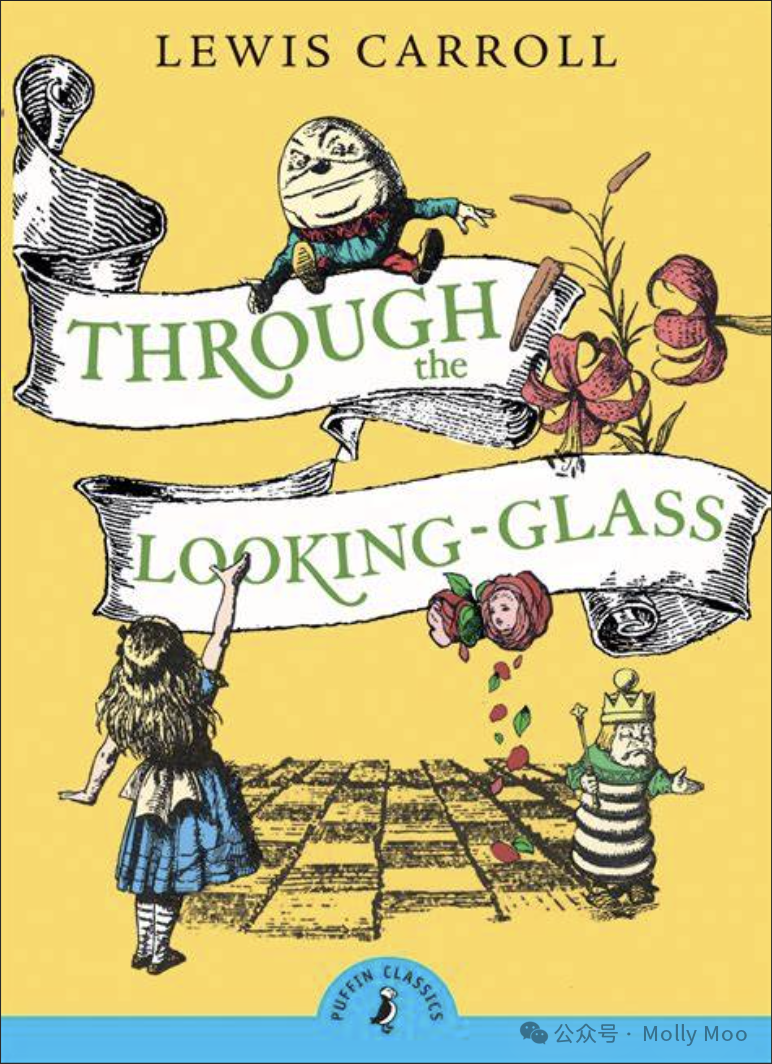
The cover of the Puffin book "Through the Looking Glass"
Hamlet (1996), Four-hour Uncut Version
In Shakespeare’s original scripted version, there is no mention of mirrors being a part of props, with the slight exception of the mirror Hamlet seeks to fetch Gertrude. In the 1996 version as well as the 2009 version in which David Tennant takes the lead role, mirrors are an important prop. Specifically, mirrors play a crucial role in visual storytelling in Kenneth Branagh’s adaptation of Hamlet (1996), especially in scenes of introspection and confrontation. Branagh’s interpretation of Hamlet as a more choleric than melancholic character brings a unique perspective to these scenes. The use of mirrors in this adaptation emphasizes the themes of reflection and self-examination central to the play. There are three notable scenes in which mirrors are involved in the film: the first when Hamlet is delivering his “To be or not to be” (referred afterward as soliloquy only) speech to his hidden audience (1:33:33; Act 3, Scene 1); the second in Gertrude’s chambers when Hamlet seeks to persuade her to keep away from Claudius (2:18:45; Act 3, Scene 4), and the third during and after Hamlet and Laertes’ duel (3:51:17; Act 5, Scene 2).
The first notable scene is Hamlet’s soliloquy, “To be or not to be,” where he stands before a mirror, questioning his existence and purpose while his uncle and Polonius spy on him. The mirror serves as a tool for Hamlet to face his inner turmoil and contemplate his identity. In his soliloquy, Hamlet asks himself whether it is more noble to live against the odds or to end his life entirely:
HAMLET: To be or not to be—that is the question:
Whether ’tis nobler in the mind to suffer
The slings and arrows of outrageous fortune,
Or to take arms against a sea of troubles
And, by opposing, end them.
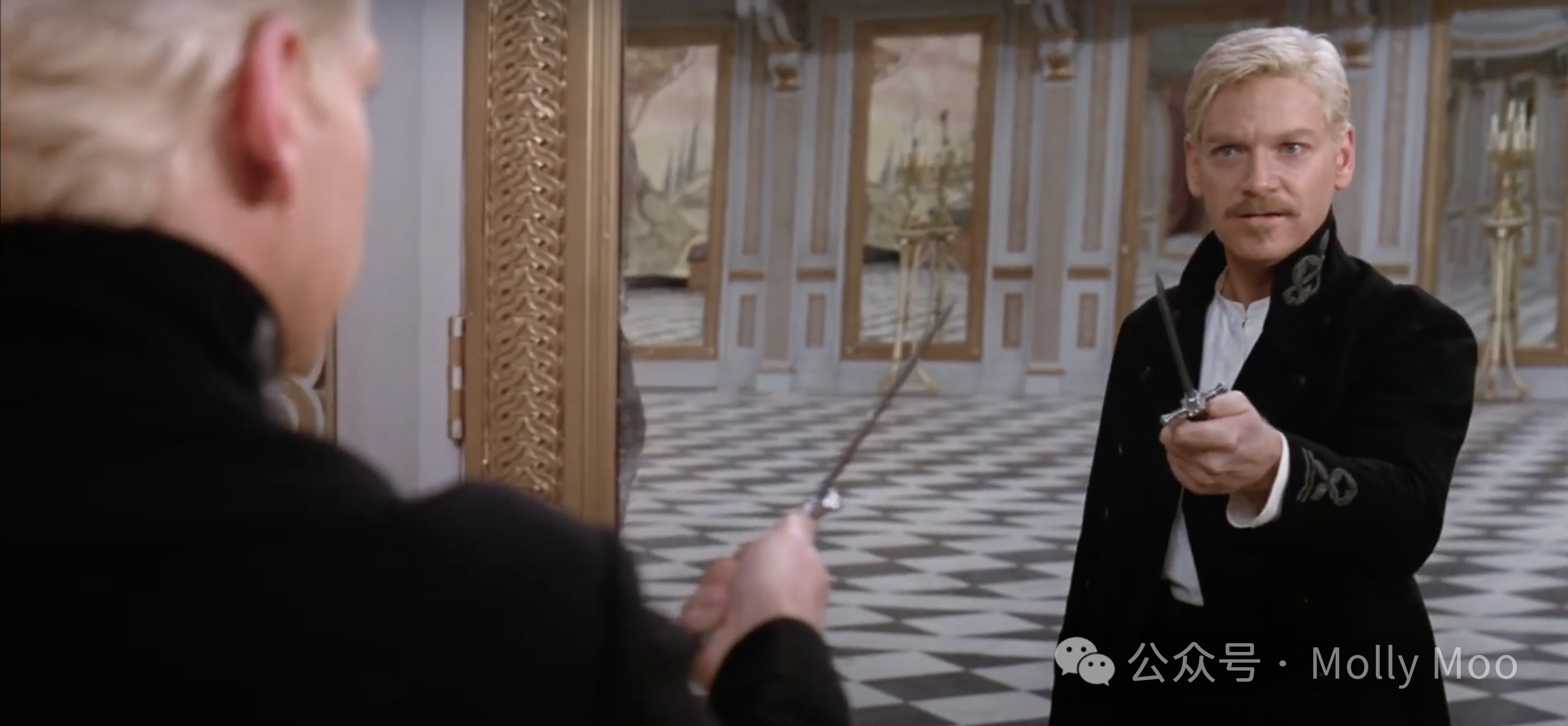
Branagh's Hamlet; "For who would bear the whips and scorns of time [...] When he himself might his quetus make/ With a bare bodkin?"
Hamlet questions himself about his choices because he wants to take the more noble path. Although he does not talk to others about suicide, he thinks to himself that it might also be a noble way of fighting against life, for he is “opposing” life by “end[ing it].” This scene highlights the dual nature of Hamlet’s character, as he grapples with the conflict between action and inaction, life and death. The mirror reflects his internal struggle, visually representing his existential crisis. Additionally, mirrors act as the threshold between the conscious and the unconscious, as mirrors trigger self-awareness and introduce us to our persona. By looking into the mirror, Hamlet can look beyond his consciousness and glimpse his subconsciousness. In one interview, Branagh mentions that Hamlet knew that Claudius and Polonius were behind one of the mirrors, so the soliloquy is also a performance for his elders. This layer of awareness adds a dimension of duplicity and manipulation to the scene, as Hamlet uses the mirror to stage his inner conflict for an external audience. The interaction between his conscious and unconscious could be entirely staged, and yet he also asks genuine questions to himself. This interaction underscores the theme of surveillance and the pervasive presence of the Other within the play.
Secondly, in Gertrude’s chambers, there is a mirror sitting on the desk that shows Old Hamlet’s figure as he is going away even though Gertrude cannot see anything. This scene is in the original Shakespearean script (Act 3, Scene 4):
HAMLET: Come, come, and sit you down; you shall not budge.
You go not till I set you up a glass
Where you may see the ⟨inmost⟩ part of you.
[Stabs Polonius, etc.]
Enter Ghost.
HAMLET: Save me and hover o’er me with your wings,
[…]
QUEEN: Alas, he’s mad.
[…] Whereon do you look?
HAMLET: On him, on him! Look you how pale he glares.
[…]
QUEEN: To whom do you speak this?
HAMLET: Do you see nothing there?
QUEEN: Nothing at all; yet all that is I see.
[…]
Upon entering her chambers, Hamlet orders his mother not to move so that he can fetch a mirror to let her see her “in[ner]most” self. This instance of the mirror coincides with the idea that through the mirror one can identify one’s Other, thus understanding their innermost self. Hamlet, bringing a mirror to his mother, aims to let her understand that she has betrayed Old Hamlet to be married to Claudius. When he stabs Polonius, all this is forgotten and instead, he shows her pictures of Old Hamlet and Claudius. He then makes a comparison between his uncle and his father to make his mother understand that she must stay away from Claudius. This is a covert use of the mirror, in which two personalities are compared. Hamlet reminds his mother of how Old Hamlet is better than Claudius, thereby trying to make his mother understand Old Hamlet better. After this speech, Hamlet sees his father standing in his mother’s chambers and speaks to him, but Gertrude cannot see her dead husband’s figure. However, in the movie, the edge of Old Hamlet’s cloak is reflected in the mirror as he turns away, symbolizing his lingering presence and influence of the past within the present as well as the buried truth. This reflection suggests that although Old Hamlet is no longer alive, his memory and the impact of his life and death continue to haunt the characters, particularly Hamlet. The mirror serves as a metaphor for the inescapable past, shaping the actions and decisions of those still living. Gertrude’s inability to see Old Hamlet, even though his image is partially visible in the mirror, highlights her denial or inability to confront the past and the truth about her actions. The reflection also symbolizes the distorted reality that Hamlet perceives, where the truth is obscured and only partially visible, much like the incomplete image of his father in the mirror. This scene underscores the theme of appearance versus reality that runs throughout the play, with the mirror reflecting not just Old Hamlet’s cloak but the complex, hidden truths that haunt the characters in Hamlet.
In the final minutes of the film, Claudius and Gertrude are dead, Laertes dying, and Hamlet lying half-dead in Horatio’s arms, delivers his speech, then finally dies, leaving Horatio alone amid the dead bodies. The mirrors here represent the fragile nature of human life and the constructed reality in which the characters live. After Hamlet’s death, there are a few seconds of empty script, where Horatio stands and nothing happens. The quiet does not last long and is sharply contrasted when Fortinbras’ soldiers smash all the mirrors in the Grand Hall, both on the first and the second floors, and the movie comes to a near end. The mirrors in the Great Hall have been the setting for several important scenes, such as the marriage of Claudius and Gertrude, Hamlet’s soliloquy, Ophelia’s madness, and lastly the duel between Hamlet and Laertes. The breaking of the mirror symbolizes the end of the façade that Claudius has taken and the end of deception. The arrival of Fortinbras’ soldiers also heralds a new beginning for Denmark under perhaps foreign rule. The destruction of the mirrors which symbolizes corruption, deceit, and tragedy, suggests the dismantling of the old, corrupt order and the establishment of a new regime. Fortinbras’ presence signifies hope for a more straightforward, honest rule as Hamlet leaves the kingdom to him:
HAMLET: […]
But I do prophesy th’ election lights
On Fortinbras; he has my dying voice.
Another more insignificant example further reveals the role of mirrors in Hamlet. In the scene before his soliloquy, Hamlet is in his room chastising himself for not being brave enough to speak his mind to Claudius. As he reaches the emotional climax of his rant, he goes near the bookshelves to the left of the camera, and there on the ground is a mirror propped against his books. This mirror reflects his movements when he moves away and towards the mirror in a frenzied manner, and although it is not specified, it perhaps further spurs his anger because he can see himself in it.
Throughout the film, mirrors symbolize the characters’ internal struggles with identity, revenge, self-indulgence, and morality, highlighting the presence of the Other within themselves. Hamlet’s interactions with mirrors serve as moments of self-confrontation, where he is forced to confront his fears and uncertainties.
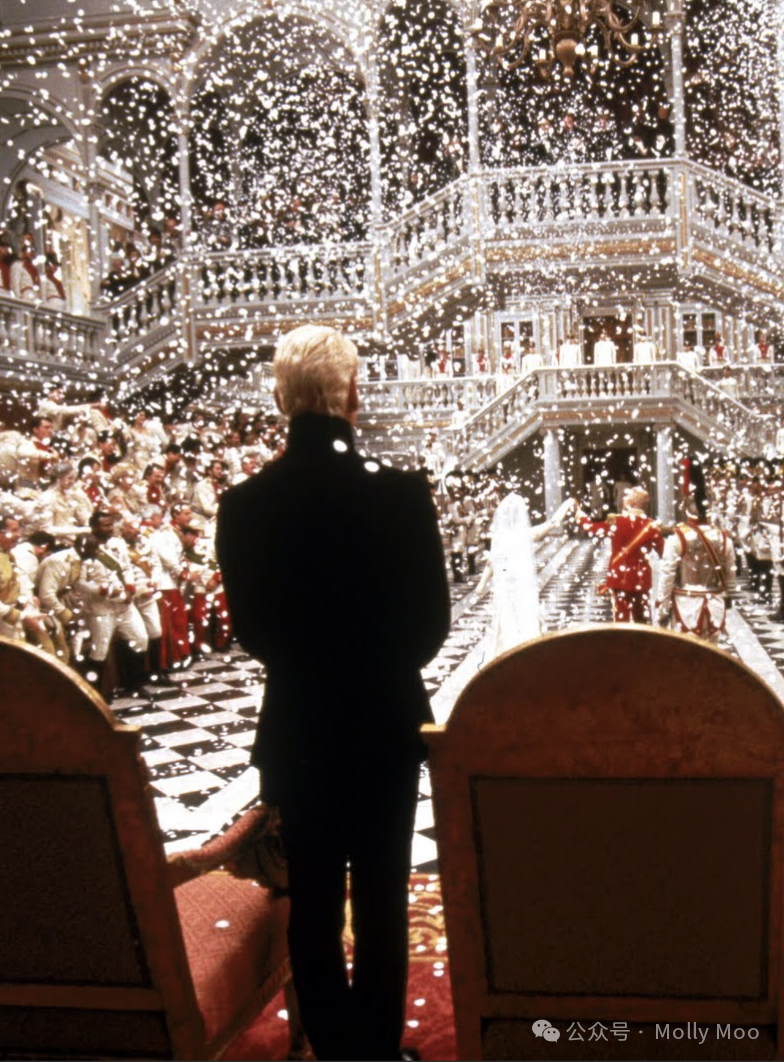
Poster scene of Hamlet (1996); Hamlet watches Gertrude and Claudius who are happily wed
Conclusion
This essay has studied the presence of mirrors in world-famous literary pieces, analyzing their role to provide insight into the characters. Encompassing the discussion of mirrors in different pieces of literature, including “Snow White”, Through the Looking Glass, and Hamlet (1996), the uses of mirrors in these pieces reveal their relationship with the Other while disclosing the characters’ inner thoughts, leading to deeper insights into who they are and what motivates them. This encounter with the Other is essential for understanding one’s own identity and place in the world.
This essay argues that in classic as well as contemporary literature, mirrors hold an important role as they often underscore in characters an internal struggle, a new self-perception, or the use of mirrors in literature old and new underscores an internal conflict, a new perspective on oneself, or a strong desire that spurs more reflection and self-discovery. As well as pushing the plot forward, mirrors also hold symbolic meaning in the way that they provide cultural, spiritual, and representations of truths.
In “Snow White,” the Queen’s interaction with the mirror forces her to confront her insecurities and drives the narrative conflict. The mirror serves as a reflection of her inner fears and desires, leading to her downfall. In Through the Looking Glass, Alice’s journey through the mirror world challenges her to navigate a landscape that defies conventional logic, highlighting the fluidity of identity and the process of self-discovery. The mirror is a gateway to the subconscious, allowing Alice to explore the complexities of her Self. In Branagh’s adaptation of Hamlet, mirrors emphasize themes of reflection and self-examination. Hamlet’s interactions with mirrors serve as moments of self-confrontation, highlighting his internal struggles and the pervasive presence of the Other. The breaking of mirrors in the final scene symbolizes the end of deception and the beginning of a new order.
Moreover, mirrors serve as a metaphor for the duality and multiplicity of the self. They reflect not only the physical appearance of characters but also their inner worlds, revealing the complexities and contradictions that define human existence. The act of looking into a mirror becomes a moment of self-confrontation, where characters are forced to reconcile the different facets of their identity.
In conclusion, the use of mirrors in “Snow White,” Through the Looking Glass, and Hamlet (1996) highlights the profound significance of reflection and self-examination in literature. Mirrors serve as powerful symbols of the Other, prompting characters to confront their inner fears, desires, and insecurities. This encounter with the Other is essential for understanding one's own identity and place in the world. Through their reflections, mirrors reveal the complexities and contradictions of the human psyche, offering rich insights into the nature of self-perception and identity. The use of mirrors in literature thus emphasizes the dynamic relationship between Self and Other, providing a deeper understanding of the human experience.
Bibliography
Glass and Mirrors (384 books). (n.d.).
https://www.goodreads.com/list/show/28182.Glass_and_Mirrors?page=4
Golden, J. M., & Donna Canan. (2004). “Mirror, Mirror on the Wall”: Readers’ Reflections on Literature through Literary Theories. The English Journal, 93(5), 42–46. https://doi.org/10.2307/4128934
Hodges, P. (2023c, August 15). Reflect the Past: Exploring Medieval Mirrors. Medieval Historia. https://medievalhistoria.com/reflect/
Comments are disabled.